


Standard parts. Custom engineering. One trusted supplier.
SELF-LUBRICATING BEARINGS
Maintenance-free sliding bearings engineered for extreme loads, wide temperature ranges, and demanding industrial environments.
NO GREASE REQUIRED
Solid lubricant uniformly embedded in the metal structure
−200°C to +800°C
Wide operating temperature range depending on alloy
HIGH LOAD CAPACITY
Static loads up to 400 MPa
The technology
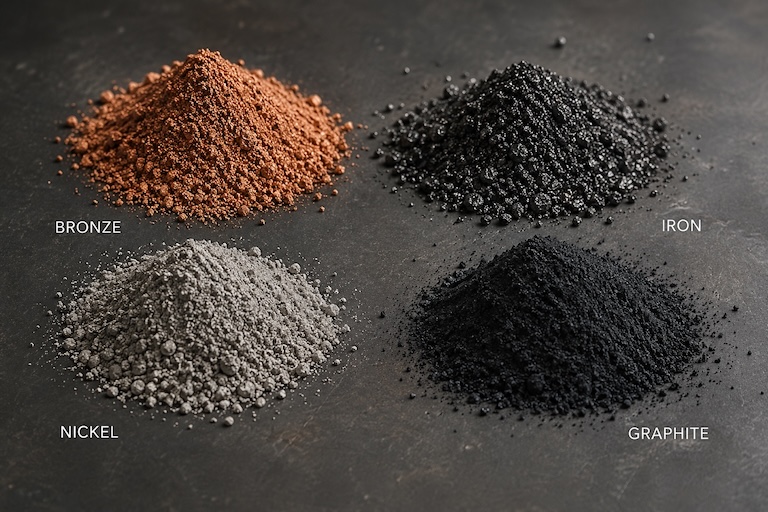
Billet bearings are manufactured using powder metallurgy from four base material groups: bronze, iron, nickel, and stainless steel. Solid lubricants — graphite, molybdenum disulphide, or manganese sulphide — are uniformly embedded throughout the metal matrix at the point of manufacture.
From the very first movement, controlled micro-wear releases lubricant particles onto the mating surface, building up a stable transfer film. This film maintains a consistently low coefficient of friction throughout the bearing’s service life — even under high static and dynamic loads, in contaminated environments, or where movement is infrequent.
No grease points. No lubrication intervals. No maintenance.
Operates reliably from −200°C to +800°C without lubricant degradation, depending on alloy.
The solid lubricant traps contaminants and absorbs impact stress, protecting the sliding surface in abrasive or contaminated environments.
Absorbs no water and resists corrosion in marine and offshore environments. Suitable for use in seawater and many industrial liquids.
No electrostatic charging effects. Suitable for applications where static build-up is a concern.
Trusted by
Materials
Billet bearings are available in more than 60 alloy variants across four base groups. Bronze-based alloys cover most standard applications up to 150°C. Heat-treated bronze alloys extend this to 350°C. Iron and iron/nickel alloys handle temperatures to 600°C and beyond. Nickel and stainless steel alloys are selected where high chemical or corrosion resistance is required.
The percentage, type, and distribution of the solid lubricant — fine, medium, or coarse — is determined by sliding speed, specific load, temperature, and other operating conditions. This means defined tribological properties can be engineered for each application.